Sign In
Breaking
 Free Newsletter


Glenn Polyn//July 1, 2025//


President Donald Trump’s sweeping tariffs have given many American consumers a bad case of whiplash. For pet parents, the impending economic uncertainty is made even more daunting as they await their local pet store to announce price changes for their pet’s favorite food, treats, toys or other product.
Among the latest levies Trump has imposed is a 10 percent baseline tariff for most imports and a 30 percent tariff on most Chinese goods. Some goods, such as steel and aluminum, face higher rates.
While the tariffs are expected to disrupt the current supply chain, including create significant delays, for some products, this certainly has a positive impact on one segment of the pet industry; products that are made in the United States.
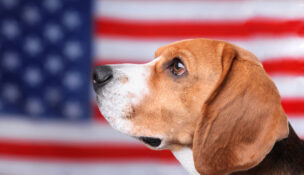
Pet stores are likely going to be displaying more red, white and blue this summer, as the “Made in the U.S.A.” trend is arguably more popular than ever before.
Labels and logos calling out a product being “Made in the U.S.A.” is often synonymous with superior craftsmanship, stringent quality controls and a commitment to ethical production practices. For pet retailers, this means an opportunity to offer products that resonate with consumers on a deeper level, building trust and loyalty in the process.
Barker Beds is a pet brand that invented a proprietary three-stage blend of American-made foam that supports a pet’s joints. Louisa Marvin, marketing director of Barker Beds, shares the benefits of the brand using U.S.-sourced materials for its beds, which are made in Streetsboro, Ohio.
“At Barker Beds, we use American-sourced orthopedic foam and upholstery-grade fabrics not just for quality, but for trust,” Marvin explained. “Sourcing materials domestically ensures consistency, durability and safety that meets or exceeds U.S. standards. This allows us to confidently say that our beds support better, deeper sleep for dogs, especially large breeds and seniors who depend on proper joint support.”
Marvin says that, with the ongoing uncertainty around global tariffs and import duties, U.S.-based manufacturing offers a key competitive edge.
“We’re insulated from the volatility affecting overseas supply chains, which allows us to keep our pricing and fulfillment more stable,” she noted. “In a world of rising costs and unpredictable delays, domestic production isn’t just a preference, it’s a strategic advantage.”
Even before the current tariffs, the concept of “Made in the U.S.A.” has been a big deal to consumers, especially after the 2007 melamine contamination of pet food. Since then, customers like to know where the products they buy — particularly pet food — come from, and they want to feel confident about feeding them to their pet.
Although demand for U.S.-made has primarily been in the consumables segment, it’s not surprising to know that two questions most consumers ask when buying a pet toy are No. 1, Where is it made? and No. 2, How long will it last?
However, due to today’s global economy, it’s not always easy to distinguish products that have 100 percent domestic content.
In the case of pet food, treats and supplements, while a large majority of ingredients that brands source are from the United States, some ingredients simply aren’t available domestically. Thus, brands need to source these items from outside the country for them to include the best quality ingredients in their product. Other countries have reputations for producing high-quality ingredients; for example, lamb and green-lipped mussels from New Zealand.
In addition, ingredients might be sourced from another country due to seasonal availability or that the exotic ingredient is not native to the U.S. or not available in an adequate supply to meet the brand’s demand, such as duck from Canada.
Making things even more complicated is the realization that “USA-sourced” does not necessarily mean that the ingredients were grown in the country. A company could conceivably purchase ingredients from an importer who buys and re-sells Chinese ingredients; therefore, these ingredients could still be described as “USA-sourced.”
Many members of the pet industry feel that consumers generally are focused on where products are manufactured and, if the product is assembled in the U.S., that creates a sense of relief.
Yet, while most consumers are more concerned with where a product is manufactured, they have less of an interest in where its base materials are sourced. Though public awareness doesn’t often extend to where manufacturers source materials for hard goods, the reality is it might be difficult for customers to identify exactly where materials in a specific non-consumable product truly come from.
However, this might eventually change as “transparency” is becoming such a popular buzz word that product awareness could one day expand into the area of materials sourcing for every product they bring home – not just for food and treats. After all, pets are commonly considered a member of the household, and if consumers wouldn’t give something to their child, why would they give it to their dog or cat?
The public perception is that products made in the U.S. represent higher quality over those made elsewhere, and this is primarily because consumers often believe U.S.-made products are being held to higher safety standards. It should come as no surprise that durables, such as toys or beds, associated with China are typically perceived to be of lower quality.
To make matters worse for Chinese imports, a May 2025 press release from the U.S. Consumer Product Safety Commission (CPSC) warned consumers to stop using certain Chinese-made bathroom and kitchen faucets sold on Amazon that can leach lead above federal safety limits into drinking water.
The CPSC found that the brands — CEINOL, KZH, Rainsworth and VESLA HOME — lacked required safety certifications and may be releasing unsafe levels of lead. According to the report, these faucets, priced between $30 and $70, were purchased by thousands of Americans.
Prolonged exposure to heavy metals like lead has been linked to learning disabilities, autism, cancer, kidney disease, birth defects and cardiovascular problems.
Consumers appreciate transparency at every level, beginning with the manufacturer and including the retailer, so that they can make a buying decision that is in keeping with their own preferences.
That’s one reason that Adam Baker, founder and CEO of SodaPup in Boulder, Colorado, was committed to American manufacturing from the inception of his pet brand.
“The first reason is that there is a strong consumer preference for American-made products,” he explained. “We are in the business of giving consumers what they want, so American manufacturing was important for us to figure out.”
By making his products in the U.S., he can have more control over his supply chain, ensure fair wages and safe working conditions — and he can have greater confidence in the safety of the materials.
“At SodaPup, we have strategic partnerships with five domestic suppliers,” Baker noted. “Two of them are within 15 minutes of our office. We can get to these factories quickly and easily, to problem-solve new product development, to build our relationships, to enhance our communications and to work more closely with them. These personal relationships enable us to move quickly on opportunities and to solve problems quickly when issues arise.
“Logistics are also far easier with domestic manufacturing,” he added. “With international logistics you have to transport the goods from the factory to the port, get loaded into a container, get loaded onto a ship, sail across the pacific, get offloaded at a port, get removed from the container, get put on a truck and driven to the brands warehouse… Lots of steps and lots of costs and lots of extra time. With U.S. manufacturers, we simply schedule a pick-up, and the goods arrive at our door in three to five days.”
Baker believes there is an advantage for retailers because many American consumers want to purchase American-made brands.
“I think nearly all American consumers would choose an American-made product over a foreign-made product if all other things were equal,” Baker said. “Given the current trade war, there is definitely an advantage for retailers to buy American-made products. The reality of the situation is that many pet products are made in China and the 145 percent tariff on Chinese imports essentially stops trade with that country. Brands that produce there either need to cancel purchase orders, creating an inventory problem, or they need to raise prices dramatically. Thus, retailers will face serious challenges – they risk not having products on the shelves or steep price increases. Neither one is a good option.”
Consumers, especially millennials — now the largest demographic that own pets — want to have more transparency with regard to ingredients and want more information about the products that they give their pets. A dedication to transparency drives Natural Cravings USA. From its inception, Natural Cravings was created on the belief that prioritizing quality could make a significant difference. When it comes to defining a Natural Cravings dog treat, the emphasis is on purity, transparency and safety.
“Our treats are proudly 100 percent made, sourced and processed in the U.S.A.,” explained Lucy Calamari Caprez, marketing director at Natural Cravings USA. “This commitment serves as a guarantee to pet owners that every treat originates from American pastures, undergoes local processing and is packaged with meticulous care. By eliminating the uncertainties associated with products processed in distant locations, we provide peace of mind to pet owners concerned about spoilage or potential health risks.”
The brand is dedicated to purely American-made products, which enables it to have a unique identity from its sister brand, Barking Buddha Pet. As Caprez describes it, Barking Buddha Pet was created to offer pets high quality treats and chews of other origins without changing the original brand, Natural Cravings USA.
“All of our ingredients, meaning 100 percent of each formula and 100 percent of the body parts we make under the Natural Cravings USA brand, are solely of U.S.A. origin,” she said.
Purrniture, a cat furniture brand based in St. Paul, Minnesota, was born from using discarded wood materials from the electrical and construction industry, and carpet remnants too small to be useful as floor covering. This approach keeps high quality materials from ending up in landfills and also makes for high quality cat furniture.
The brand creates a full line of furniture from simple Desk toppers for the home office to Scoops designed to hang on the wall, saving floor space, to its Castle Royale, which is designed to support eight cats.
According to Darryl Michaelson, founder of Purrniture, everything he uses to make his cat products is sourced from U.S.-based manufacturers.
“It’s been my secret sauce,” he said. “I’m repurposing materials from the paper industry, fence companies and salvage yards. All the carpet I get are shorties and remnants and end of rolls from carpet companies.”
Although he believes that his products being made in the U.S.A. has been beneficial for his brand, he’s noting an uptick this year in the demand for American-made products.
“I believe there’s a resurgence coming in of ‘Buy American’ – it’s a big selling point now – stating that something is American made. There’s a newfound pride having our products made here again.
Michaelson notes that the feedback he receives on his being an American-made brand is always positive.
“It’s 100 percent positive,” he added. “Just this week I had two customers – one in New York called and said she came across my website, and she wants to buy American. She stated several times that she wants to keep the money in the U.S. Another guy, who lives in Maryland but was visiting his in-laws in Minnesota, called me and he found out that he was a half hour from a shop that carries my cat furniture. He told me he was heading to the shop because he likes to buy ‘local’”
Ultimately, retailers play a large role in the success of American-made products. As Marvin from Barker Beds sees it, carrying pet products that are made in the U.S.A. not only meets the rising demand, but it also enables them to differentiate their assortment from their competitors.
“Retailers today need to offer products that go beyond comfort, they must convey credibility, ethical sourcing, and premium value,” she said. “Made in the USA resonates deeply with today’s pet parents, especially those seeking safer, longer-lasting products.”
Shelf signage, window displays and special “Made in the U.S.A.” sections can help retailers take advantage of their customer knowledge, and position products for maximum exposure and sales.
With only so much space, it might not be feasible to pull all products that are made in the U.S. and create a separate section in a store. However, at the very least, an endcap or something special near the front of the store — especially around patriotic holidays — can help draw attention to the category.